Updated 24 November 2026 · By Tammy & Benjamin
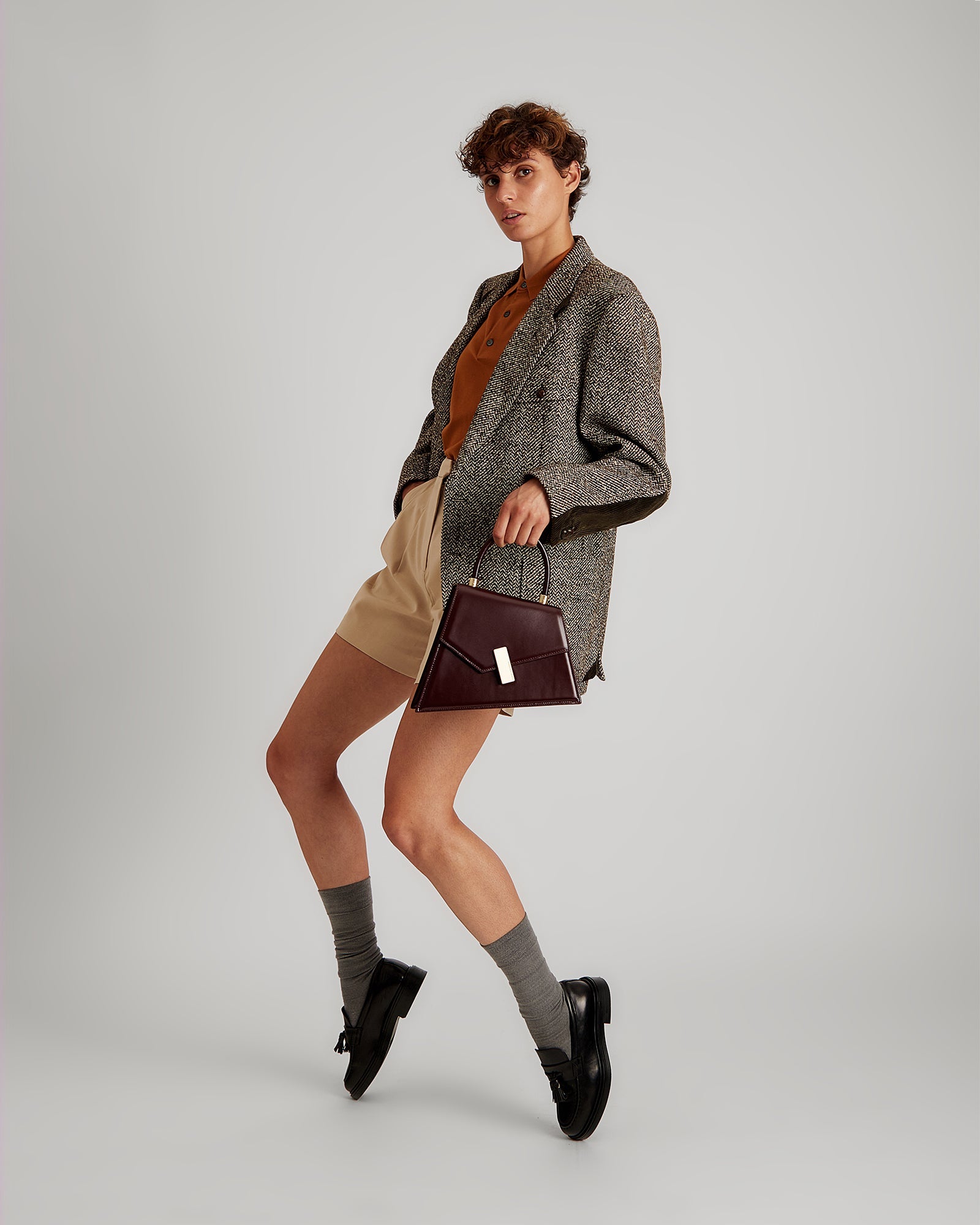
In leather goods, the flap is the oldest and most expressive part of a bag. It closes, it protects, and it gives the bag its face. On the THEA, it covers almost the entire front: it is the design. To understand this bag, you have to look at where the flap comes from, and what Tammy made of it.
Two families of bags brought together
The history of the woman's bag in the twentieth century lies largely between two forms. On one side, the envelope clutch of the 1920s and 1930s: flat, closed by a large flap, carried under the arm or held in the hand, often decorated with geometric patterns. On the other, the structured handbag that took hold in the middle of the century: a volume that stands up, a handle on top, the accessory of a dressed-up outfit.
The THEA borrows its large flap from the first and its structure and rigid handle from the second. A fine, adjustable, detachable strap then takes it to the shoulder or cross-body. That last gesture comes from Hong Kong, where Tammy grew up: a city bag must follow its owner all day.

An Art Deco geometry
The name Art Deco comes from the International Exhibition of Modern Decorative and Industrial Arts, held in Paris in 1925. The style it established favours simple, symmetrical forms, clean flat surfaces and precious materials: lacquer, rare woods, polished metal. It looks for elegance in the line rather than in ornament.
The THEA speaks this grammar. The flap divides the front into two clear surfaces, and the relationship between body, flap and handle is set like a small building façade. Tammy readily names architecture, geometric forms and the French elegance of the 1920s and 1930s among her references. She reads them through Hong Kong modernism, hence clean lines with a touch of nostalgia.
The Art Deco Colourblock version makes the kinship explicit. Its hand-brushed marbled leather is inspired by the precious woods and lacquers of the period.

What a large flap demands
A flap this size forgives nothing. It is the largest visible surface of the bag: the cut of the leather, the evenness of the stitching and the finish of the edges can be read at first glance. It must also fall exactly, without buckling, and keep its line through years of opening.
For a structured bag to hold, the leather is backed with reinforcements that give it support without making it stiff. It is a craftsman's balance, set through successive trials. Our partner workshops in Italy take part in this development, on materials, construction and adjustments. Every THEA is checked during production, then inspected one last time in Paris.
One design, several surfaces
A form this graphic lends itself to changes of material, and each one changes how it reads:
- Coated smooth leather: a fine finishing film protects the surface and gives it a clean hold. This is the most architectural version, where the line dominates.
- Naplak leather: a crinkled, luminous surface with shifting reflections. The flap becomes a play of light.
- Embossed leather: a crocodile or lizard pattern is pressed into the leather, then brushed by hand. The relief softens the geometry.
The THEA MINI takes the same design to another scale. Its proportions have been kept, which is harder than it looks: shrinking a bag without distorting it means redrawing every ratio.

Standing out without being loud
The THEA carries no visible logo. It is recognised by its silhouette, the most demanding form of signature in leather goods. It has been the Maison's idea since 2013: stand out without being loud. It is also what makes it one of our five signatures, alongside the EMMA, the CUBIST, the ALEXIA and the GABRIELLE.
To go further, see the story of the Maison, our materials and our signature models.